

You’ve spent years building a wine list worth talking about. The right producers, the right lighting, a tasting table that’s always ready.
But when someone in your town searches “wine shop near me,” “independent wine shop in [your town],” or even “how to find a good wine shop nearby,” your shop doesn’t come up. Google suggests a chain three miles away instead.
That’s not a wine problem. It’s a visibility problem—specifically how your wine shop shows up (or doesn’t) in Google Maps and local search. You can fix this by optimizing your digital footprint or using a tailored local wine SEO service to attract nearby buyers. Let’s look at how to fix that with this local SEO for wine shops guide.
How do you improve Local SEO for a wine shop?
To improve local SEO for a wine shop, the business should claim and verify its Google Business Profile, choose the most precise categories, keep hours and contact details current, and make sure its Name, Address, and Phone information matches across the web.
It should also collect fresh customer reviews, reply to them promptly, add high-quality photos and videos, and use locally relevant website pages and title tags that reflect the town or area served.
Google’s local results still depend mainly on relevance, distance, and prominence, so a fast, mobile-friendly website remains important, but it is not the only factor that affects Local Pack visibility.
In This Local SEO for Wine Shops Guide:
- The Foundation
- Connecting with Customers
- Building Local Prominence
- Technical Backbone
- Staying Ahead
- Frequently Asked Questions (FAQ)
THE FOUNDATION: How Wine Shops Rank in Google Maps
1. The Reality of the Local Pack
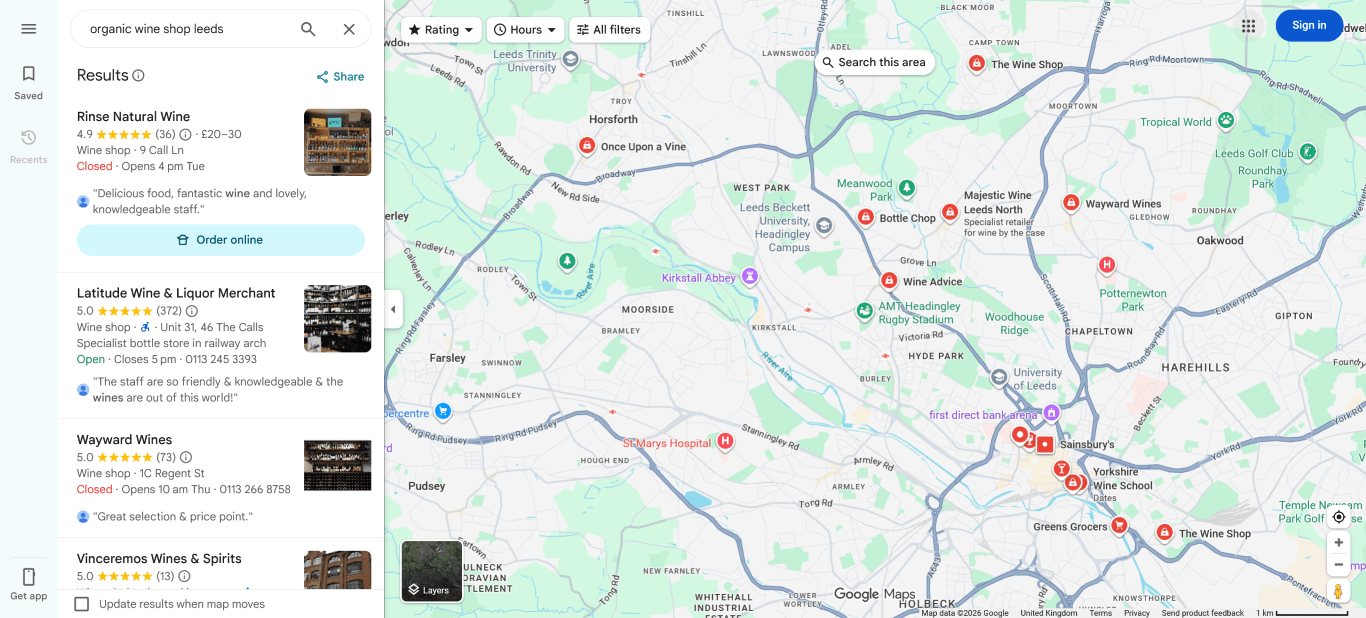
When someone searches for wine nearby, Google shows a map with three featured businesses. That’s the Local Pack, and it’s the first thing most people click.
Getting into those spots isn’t about budget. Google ranks by relevance, distance, and prominence. If your shop is two minutes away but your online information is inconsistent or incomplete, Google may show a competitor a mile further who has their details in order.
2. Your Google Business Profile is Your Digital Shop Front
If you haven’t claimed your Google Business Profile, you’re leaving your best shelf facing the wall. This profile often appears before your own website in local searches — it’s where customers check your hours, see your photos, and decide whether to visit.
Claim it at business.google.com. Search for your shop, claim the listing, and follow the verification steps (or, if you want me to handle the technical verification and setup for you, check out my Local Wine SEO package). Once verified, fill it out properly based on what actually moves the needle on the high street:
- Photos: Don’t just upload generic bottle shots. Upload at least five specific angles: your street-facing entrance (so people recognise it walking by), your actual regional shelf layouts, your team behind the counter, and a couple of interior shots showing the atmosphere. In my experience working with independent merchants, profiles that display real, human shop floors see an immediate spike in mobile “Direction Requests” compared to those using stock images or clean e-commerce packshots.
- The Products Feature: This is one of the most underutilized tools in the wine trade. Use the built-in Products tab to list high-intent arrivals like rare allocations, orange wines, or natural wines. Supermarkets leave this blank because their inventory is too massive to manage manually; listing your specific hero bottles here gives you an instant technical advantage in local search.
- Hours: Keep them accurate down to the minute, especially for bank holidays or tasting event nights. Wrong hours generate swift one-star reviews, and Google’s local algorithm actively demotes profiles with a sudden drop in review ratings. Few things are more annoying to a customer than finding the shop closed, when it’s Google Maps listing claimed it was open. Believe me, I’ve dealt with those annoyed customers myself.
- Categories: Set your primary category strictly to “Wine Store” or “Wine Shop.” Add relevant secondary categories — “Wine Bar” if you have a premises license for on-consumption and run regular tastings, for example — but only if they genuinely describe your weekly operations. Don’t pad it; Google cross-references your website text to verify these categories, and conflicting data drops your map visibility.
If your shop is not showing up on Google Maps at all, start here: Why is your wine shop not showing up on Google Maps?
3. Keep Your Details Consistent
Google checks your Name, Address, and Phone Number across the web. If your website says “The Wine Cellar” but your Facebook page says “Wine Cellar Ltd,” that inconsistency makes Google less confident in your business, and less likely to show it.
Go through your website, social profiles, and any local directories. Make sure every listing uses exactly the same name, address, and phone format. If you abbreviate “Street” to “St.” in one place, do it everywhere. In reality, Google’s systems are smart enough to distinguish between different versions, but our job is to make its job easier, not challenge it to solve pointless puzzles.
4. Reviews: Recent and Responsive
In the wine trade, a personal recommendation goes a long way. Online, recent reviews work in a similar way, and Google looks at review activity as part of a business’s overall prominence.
Ask for reviews as a regular part of your checkout routine rather than only inviting your happiest customers. Google’s policies prohibit review gating, which means you should not selectively ask only for positive reviews.
When wrapping up a purchase at the counter, say: “We really appreciate your business — if you have a moment, would you mind leaving us a quick Google review about your experience?” In my experience, making the review-leaving process seamless is the best way to increase review numbers, and a tried-and-tested way of doing that is displaying a QR code near the till that links straight to the review page, making it easy for customers to leave feedback. Just don’te pressure them or offer incentives. It’s against Google rules and can get you in trouble. To learn more about Google reviews strategy read How to Get Real Google Reviews for Your Wine Bar or Shop Without Getting Banned.
The review process doesn’t end with the customer. Your job is to reply to every review. I personally do it weekly. Thank five-star customers by name, and address lower ratings calmly and constructively. Consistent replies help show customers that there is a real person behind the shop, and proves to Google that you’re a considerate, active merchant who cares.
CONNECTING WITH CUSTOMERS: How to Turn Local Searches Into Wine Shop Customers
5. Write for Your Customers, Not Wine Professionals
Your website copy isn’t for Masters of Wine. It’s for the person who wants something good for Friday night and doesn’t know where to start.
When writing copy for your website, act as if you were standing by the tasting counter, glass in hand, chatting to a customer. Here’s a mini quiz. Would you say:
“This complex, estate-bottled vintage exhibits a high concentration of anthocyanins and an optimal pH balance, resulting in a structurally sound, tannin-forward palate that displays distinct micro-climate terroir characteristics”
Or would it sound more like:
“This is a big, bold red from a tiny hillside vineyard, so it’s got a brilliant, deep color and a lovely grip to it—perfect if you want a serious bottle for a steak night”
Which one do you think makes a customer pick up a bottle and which will cause them to run for the hills?
Keep the overly technical info for trade conferences. On your website, swap “diverse portfolio of artisanal producers” for “wines for dinner, gifts, and nights in.” Replace technical terroir talk with “great wines from small producers who really care about what they’re making.” Write in short sentences. Use active voice.
Remember the test: would you say it to a customer standing at your counter? If not, rewrite it.
Content that reads naturally to real people also reads naturally to Google. That’s not a coincidence. Google’s official guidance reminds us that casual users search using completely different language than experts. While a seasoned collector might search for “Cru Bourgeois Bordeaux,” your Friday-night buyer is more likely to search for a “smooth dinner party red.”
As part of my wine SEO process, I review content regularly to ensure your text matches these seasonal local search trends, like shifting from ‘heavy reds’ to ‘chilled reds’ as the weather changes.
If you’d rather focus on wine than writing words, I can help with your wine SEO copywriting. I handle all copy, from page text to headings, so your expertise comes across without the jargon.
6. Create Localized Content for Your Neighborhood
Generic blog posts about the history of Chardonnay won’t bring local foot traffic through your door. Writing about your specific area will.
Create local guides like “The Best Wines for a Picnic in [Local Park Name].” Mention nearby restaurants that allow BYOB and suggest the perfect bottle to bring along. Reference local landmarks. When your content consistently connects your shop to the physical neighborhood around it, Google starts to see you as the definitive local authority and not just a generic wine website, but the go-to wine shop for your specific postcode.
Not sure how to map out your local content? I help independent wine merchants design simple, practical wine SEO content marketing strategies that attract nearby customers. Get in touch and we’ll map it out together.
7. Optimize Images for Local SEO
Every image you upload carries a signal for search engines. Don’t leave files named “bottle.jpg” or “IMG_4823.” Rename them descriptively before uploading: a file name like "natural-wine-display-shelf.jpg" tells Google exactly what the image shows, whereas “image1.jpg” tells it nothing.
Always add alt text to every image as well. This is where you can safely connect the image to your business and location. For example: “A wooden shelf stocked with natural organic wines inside our [Town Name] shop.”
This helps search engine crawlers understand your visual content, ties it directly to your physical neighborhood, and improves accessibility for visually impaired visitors—all without awkwardly stuffing keywords where they don’t belong.
8. Video: Lower Bar Than You Think
You don’t need a high-end production team to stand out. A simple 30-second clip filmed on your phone of you opening a new bottle, talking through a weekend delivery, or describing a quick food pairing is more than enough.
Video content naturally boosts how long potential customers stay on your listing. Regular activity shows Google that your profile is active, relevant, and being maintained. Best of all, a quick video achieves something text alone never can: it immediately proves to a local browser that there is an approachable, real-world expert waiting behind the counter.
BUILDING LOCAL PROMINENCE: How to Build Local Authority for Your Wine Shop
9. Local Links and Community
A link from another website to yours signals trust to Google. While a mention in a big national wine publication is great, links from your high street neighbors are actually far more powerful for local search rankings.
Talk to the bakery around the corner about a joint wine-and-cheese feature. Get your shop mentioned in a neighborhood newsletter, or host a pop-up tasting and ask the venue to link to your website. As a professional SEO content writer, I’ve found that pitching articles to neighboring business websites is a brilliant way to earn these precious links. For example, write a guest feature about perfect wine and cheese pairings for your local cheesemonger’s website, and watch your local ranking power grow.
If you sponsor a local charity or neighborhood event and they link back to you, ask them to mark the link as rel="sponsored" or, at minimum, rel="nofollow". That tells Google the link is part of a sponsorship rather than an editorial recommendation, which reduces the risk of violating Google’s link policies.
These genuine neighborhood connections build your shop’s local prominence over time. It is a gradual process, but it tells Google — and your physical community — that you are a trusted, central part of the local area.

10. Social Media for Traffic
Social media isn’t a direct Google ranking factor, but it drives real traffic to your site, and an active, engaging profile builds the kind of brand awareness that eventually walks through your physical door.
Don’t just post static bottle label shots. Post your shop interiors. Post your team. Post yourself opening something interesting. Make it human.
Crucially, always use the built-in location tag for your town or neighborhood on every post, and include the location name in your captions. Visual search algorithms rely heavily on map data and on-screen text to recommend content to nearby users. If someone is browsing what is happening in your local area, your shop needs to be part of that picture.
11. Be a Specialist
The “bad” news is that you won’t out-rank a major supermarket chain for a generic keyword like “wine.” The great news is that you don’t need to.
Specialise instead. If you are the best shop in town for orange wine, low-intervention Pinot Noir, or small-grower Champagne, make sure Google knows it. Build dedicated, permanent collection pages or guides for these specialties. Write about them in the approachable language your customers use, and keep those pages updated with your current stock and real-time tasting notes.
Google’s ranking systems heavily favor what is known as “topical authority.” Instead of rewarding sites that try to cover everything broadly, search engines actively push deep, hyper-focused experts to the top of the results. Owning a specific niche makes you the obvious choice for customers who are looking for exactly what you do—and those tend to be the passionate, high-value customers worth having.
It is also why it’s worth working with a specialized wine SEO professional and not a digital marketing generalist who won’t know his Syrah from Shiraz. A generalist will waste your budget targeting impossible, generic terms. A wine specialist understands regional trends, producer names, and buyer behavior, allowing them to map out a search strategy that captures high-intent customers who are already looking for your exact bottles.

TECHNICAL BACKBONE: Technical Local SEO for Wine Shops
12. The Mobile Experience
Most people searching for a wine shop nearby are doing it on their mobile phone while on the move. If your website takes ages to load, or makes a user pinch and zoom just to find your shop’s phone number, they will instantly back out and move on to the next result.
Test it yourself right now. Open your website on your phone and try to answer three questions:
- Can you find your physical address in under three seconds?
- Are your current opening hours clear?
- Is your phone number an instant tap-to-call link?
If the answer to any of those is no, fix it today. Put your location, opening hours, and a tappable phone number somewhere clearly visible on every single page.
Google’s mobile ranking algorithms focus heavily on responsiveness—specifically how quickly a site responds when a user taps a button or opens a menu. Use large, finger-friendly buttons, ensure your mobile menus open instantly without lagging, and keep images compressed. A mobile site that responds instantly turns local searchers into physical foot traffic; a clunky one hands them directly to your competitors.
13. Title Tags: The Easiest Win on Your Site
Every single page on your website has a title tag—this is the clickable blue headline that appears in Google’s search results. If your homepage title tag just says “Home” or “Welcome,” you are virtually invisible to local shoppers.
Fixing your homepage title tag is the fastest win in local SEO. You can use this simple, proven formula:
[Shop Name] | Independent Wine Merchant in [Town, City, or Postcode]
Keep the entire text under 60 characters so Google displays it fully without cutting it off. Be specific: “The Wine Cellar | Wine Merchant Sheffield” will always massively outperform a generic title like “The Wine Shop.” Adding your specific town or postcode tells Google’s local algorithm exactly who should see your website.
If tweaking title tags and meta descriptions sounds like a technical headache, my Local Wine SEO and Google Maps Strategy package covers your full on-page setup so you can focus on running your shop.
14. Local Landing Pages (With One Important Caveat)
If you operate more than one physical bottle shop, run a separate tasting room, or handle a major wholesale operation in a different region, a single homepage won’t be enough to capture that traffic. You need to build dedicated landing pages for each location, filled with genuinely unique content describing the local team, the specific neighborhood, and opening hours unique to that site.
But here is the golden rule: if you have exactly one shop in one postcode, your homepage is your local landing page. Do not create extra location pages just for the sake of trying to rank in neighboring towns.
Google strictly penalizes what it calls “Doorway Pages”—thin, low-quality pages designed purely to capture search traffic for multiple areas without offering a real physical presence there. Swapping out town names on duplicated text does far more harm than good and can drag down your entire website’s rankings. Focus all of your effort on making your single homepage the ultimate local authority for your exact neighborhood.
If you’re based in Sheffield, I’ve already built a dedicated resource for you: local wine SEO services for Sheffield wine businesses.
15. Schema: Help Google Help You
Schema markup is a snippet of code hidden in your website’s background that tells search engines the absolute fundamentals about your business in a data format they can read instantly. It translates your website text into a direct data feed containing your exact address, phone number, opening hours, and business type.
For a physical bottle shop, you need to use LocalBusiness Schema. The golden rule here is consistency: make sure the name, address, and phone number (NAP) inside this code match your Google Business Profile exactly, down to the comma. Once it’s on your site, use the official Schema.org Validator or Google’s Rich Results Test to confirm it is installed correctly without errors.
It won’t transform your rankings overnight, but it completely removes any ambiguity about who you are and where you are. I include full Local Business Schema implementation in my Local Wine SEO and Google Maps Strategy to ensure Google and modern AI models like Gemini or ChatGPT can crawl, understand, and categorize your business flawlessly.
STAYING AHEAD: Simple Local SEO Routine for Wine Shops
16. The Local SEO Routine: 10 Minutes to Stay Ahead of Competitors
Most local competitors set up their Google Business Profile once and then leave it alone. For independent wine shops, consistency is one of the simplest ways to stay visible in local search.
Over the years, I’ve found that the biggest hurdle for independent merchants isn’t capability. It’s time. You’re busy running tastings, managing stock, and serving customers. That is why I advise treating your digital presence exactly like your physical shop floor. To keep your routine entirely manageable, build these quick habits right into your workflow:
- Weekly: Reply to any new customer reviews, upload one clear photo of your shop window or floor, and check that your opening hours are correct for the coming week.
My tip: Treat your Google profile like your pavement chalkboard. If a rare allocation or a fresh natural wine delivery drops on a Thursday morning, snap a quick smartphone photo and post it before you open the doors. It takes 30 seconds but signals to Google that your business is active. - Monthly: Search your main local terms on your phone, such as “wine shop near me” or “organic wine [your town],” and compare the businesses ranking above you. If a competitor has moved ahead, review their profile to see what they are doing differently.
I always tell my clients to check how fast the competition is collecting reviews —are they suddenly picking up three new customer reviews a week while yours have completely plateaued? That steady stream of fresh feedback is usually the culprit. - Quarterly: Check your Google Business Profile Performance report and review the actions that matter most, including direction requests, phone calls, and website clicks. Those are more useful than vague traffic numbers when you are measuring local demand.
Quick Local SEO Checklist for Wine Shops
- Claim and verify GBP
- Add 10 real shop photos
- Set correct category (Wine Shop)
- Get 3–5 new reviews per month
- Add town name to title tag
- Post weekly photo/update
Need professional help with your SEO?
If you want an expert to handle the technical fixes, local map strategy, and content planning that gets your shop found, view my wine SEO services to see how I combine WSET-level knowledge with technical search engineering.
Local SEO for Wine Shops: Final Thoughts
Your shop exists in the real world. But for most of your future customers, it all starts online.
Admittedly, there’s a lot to stay on top of when it comes to local SEO for wine shops—and the shops that show up consistently are the ones with someone making sure the details don’t slip: a maintained profile, copy that talks to real people, and content rooted in your neighbourhood.
If you’d rather spend your time on the wine, that’s exactly what I’m here for. You can view my Local Wine SEO package or get in touch for a free consultation and we’ll start with what will make the biggest difference for your shop.
Frequently Asked Questions
How long does it take to see results from Local SEO?
Expect to see movement in 4 to 12 weeks. Google needs time to verify your updated data across multiple directories and see a consistent pattern of new reviews and local activity. Local SEO is a build, not a switch.
Do I need a blog for Local SEO?
You don’t need a high-volume blog, but you do need local content. Writing about your specific neighbourhood, nearby restaurant partnerships, or local events tells Google you are a relevant authority in that postcode. Quality beats frequency.
Is Google Business Profile free?
Yes. It is a free tool provided by Google. If you receive a call asking for a fee to “keep your listing active,” it is a scam. You only pay for professional management or optimization services to help you rank higher.
Why is my wine shop not showing on Google Maps?
If your shop isn’t showing up, it usually comes down to three common culprits: your profile isn’t fully verified, your business details (NAP) are inconsistent across the web, or you haven’t built enough local prominence yet.
First, ensure your primary category is strictly set to “Wine Store” or “Wine Shop.” If that’s already correct, the issue is usually a lack of active signals. Google actively prioritizes active merchants—meaning those with recent customer reviews, freshly updated photos, and consistent weekly profile engagement.
How many reviews does a wine shop need to rank in Google Maps?
There is no magic number, but you generally need a higher review count and rating than the top three competitors currently sitting in your local map pack. More importantly, Google looks at review velocity—the steady stream of new feedback. A shop with 30 reviews that collects two fresh ones a week will often outrank a competitor with 150 total reviews that completely plateaued two years ago.
Can I rank my wine shop on Google Maps without a website?
Yes, you can rank on Google Maps with just a fully optimized Google Business Profile, but your ranking ceiling will be heavily limited. A fast, mobile-friendly website acts as a validation engine for Google. It allows search crawlers to cross-reference your specialties, index your local content, and read your background Schema markup. Think of your Google profile as your pavement chalkboard and your website as the full shop floor—you need both to maximize your local revenue.