

If someone asks ChatGPT or Google’s AI to recommend a winery to visit this weekend, does your name come up?
For most wine businesses, the answer is no. Not because they make or sell bad wine. Not because they have a bad website. But because the way people search for wineries has changed completely and most producers have not caught up yet.
A few years ago, getting found online meant ranking on Google. You needed a decent website, a few good reviews, and maybe a blog post or two. That still matters. But it is no longer enough.
Today, a growing number of your potential customers do not search. They ask. They open ChatGPT, Gemini, or Perplexity and type something like: “Which English sparkling wine producers are worth visiting?” or “Where can I buy good Pinot Noir direct from a winery in Kent?” The AI gives them three or four names. If yours is not one of them, that customer is gone before they ever found you.
That is what AI visibility for wineries actually means. Not a hack or technical trick. Not a marketing trend. It is simply whether AI systems have enough accurate information about your business to confidently recommend you.
The good news: most wineries are not doing this yet. If you sort it out now, you are ahead.
How can wineries improve their visibility in AI search results?
To appear in AI platforms recommendations, wineries should move beyond generic brand copy and provide specific, verifiable content, such as technical details about vintage conditions, soil types, and winemaking decisions, that machines can cross-reference as expert knowledge.
Beyond content, technical accessibility is important. Wineries should ensure their business details (Name, Address, Phone) are identical across all platforms, implement valid Schema markup on their website to define their entity to search engines, and maintain a fully updated Google Business Profile. AI systems prioritize credible, machine-readable data over polished, non-technical marketing language.
Why Most Winery Websites Are Invisible to AI
AI systems do not find your winery the way a person does. They do not respond to atmosphere, photography, or brand feeling. What they look for is content that is clear, specific, and credible, and a website that is technically accessible enough to read in the first place.
According to Google, the single biggest factor in AI visibility is content that provides a unique point of view based on real knowledge and experience. Generic copy that could have been written by anyone, about any winery, anywhere, is effectively invisible. Specific detail that could only come from someone who actually makes wine is what gets cited and recommended.
I have gone through enough winery websites across the UK to notice that the pattern is the same almost every time. Beautiful design. Lovely photography. Copy that says “passionate about wine” and nothing else. No specific production detail. No real expertise on the page. That is the problem most producers need to fix first.

What AI Systems Want to Read About Your Winery
Content is what gets you recommended. The technical side is what makes you readable.
Most winery websites have the same content problem. The writing is polished, the brand story is warm, and absolutely none of it gives an AI system anything useful to work with. ‘Passionate about wine’ tells a machine nothing. ‘Hand-harvested Chardonnay from north-facing chalk slopes in the North Downs, picked in the third week of October when sugars hit 10.5 Brix’ tells it a great deal. This is not about making your shop descriptions technical. It is about having at least some pages on your site where the real detail lives — your About page, your winemaker notes, your vintage reports. That is where expertise belongs.
AI systems are pulled towards content that is specific, verifiable, and clearly written by someone who knows what they are talking about. When ChatGPT or Perplexity is assembling an answer about English sparkling wine producers worth visiting, it is not picking the prettiest website. It is pulling from the source with the most detailed, credible, useful information. That source should be you.
When I look at winery websites that do and do not appear in AI results, the ones that get cited share a few things in common. They answer real questions in plain language. They contain detail that could only come from someone who really knows their wine. And they are written for a reader, not a search engine.
What that looks like in practice:
- Your About page should explain your vineyard in specific terms. Soil type. Vine age. Aspect. Why you planted what you planted where you planted it.
- Your wine pages should go beyond tasting notes. Explain the vintage conditions. Describe the production decisions you made and why. A winery owner who writes “we delayed harvest by ten days after an unexpected warm spell in late September” is giving an AI system something real to work with.
- Your FAQ page, if you have one, is underused by almost every winery. Questions like “what makes your sparkling wine different from Champagne” or “do you ship direct to customers” answered in plain, specific language are exactly what AI systems pull from when answering customer queries.
There is a simple test worth doing right now. Open ChatGPT or Gemini and type: “What makes [your winery name] worth visiting?” If the AI draws a blank, or repeats something generic, your content is not doing the job. The fix is not more content. It is more specific content.
One thing that consistently helps is writing in the first person about decisions you made. Not “our wines are made with care and attention.” But “we switched to whole-bunch pressing in 2021 because we wanted more texture in the base wine.” That kind of detail builds credibility with both readers and machines.
Generic copy is invisible. Specific copy gets cited.
This is also where most SEO consultants fall short. They can fix your schema and clean up your indexing, but they cannot write convincingly about disgorgement decisions or why a late harvest changed the character of a vintage. I spent a decade writing about wine before I learned how search engines work. I hold a WSET qualification, a Capstone California Advanced, and I work the floor at Majestic Wine every week. I know how customers talk about wine and what they search for. If you need someone to write the kind of winemaker content this article describes, that is part of what I do. Find out more about my wine SEO content marketing services.
The Code Your Website Needs: A Plain English Guide to Schema Markup
Good content gets you noticed. But the technical side of your website needs to support it. Three things to check first.
Clean indexing. Google Search Console will tell you whether your pages are being crawled and read. If they are not, nothing else matters. Check it, fix any crawl errors, and make sure your sitemap is current.
Readable basics. Your name, address, phone number, and opening hours must appear as plain text. Not in an image, not in a PDF, not inside a popup.
Structured data. This is code that sits in the background of your website. Visitors never see it. Search engines and AI systems can read it. It labels your business so machines know what you are, where you are, and what you offer. Without it, they are guessing.
Here is what a winery schema block looks like. You do not need to write this yourself. You need to recognise it, understand what it does, and make sure it is on your site.
{
  "@context": "https://schema.org",
  "@type": "Winery",
  "name": "Blackthorn Estate Winery",
  "url": "https://www.blackthornestate.com",
  "telephone": "+44-1234-567890",
  "address": {
    "@type": "PostalAddress",
    "streetAddress": "12 Vineyard Lane",
    "addressLocality": "Faversham",
    "addressRegion": "Kent",
    "postalCode": "ME13 8XY",
    "addressCountry": "GB"
  },
  "geo": {
    "@type": "GeoCoordinates",
    "latitude": 51.3148,
    "longitude": 0.8916
  },
  "openingHoursSpecification": [
    {
      "@type": "OpeningHoursSpecification",
      "dayOfWeek": ["Saturday", "Sunday"],
      "opens": "10:00",
      "closes": "17:00"
    }
  ],
  "hasMenu": "https://www.blackthornestate.com/wines",
  "servesCuisine": "Wine Tasting",
  "amenityFeature": [
    { "@type": "LocationFeatureSpecification", "name": "Dog Friendly", "value": true },
    { "@type": "LocationFeatureSpecification", "name": "Wheelchair Accessible", "value": true },
    { "@type": "LocationFeatureSpecification", "name": "Outdoor Seating", "value": true }
  ],
  "sameAs": [
    "https://www.instagram.com/blackthornestate",
    "https://www.facebook.com/blackthornestate"
  ]
}
This block goes in the <head> of your homepage. It tells every AI system and search engine exactly who you are, where you are, when you are open, and what kind of experience you offer. The “sameAs” links connect your website to your social profiles, which strengthens your identity as a real, established business.
Your individual wine pages need their own separate block:
{
  "@context": "https://schema.org",
  "@type": "Product",
  "name": "Blackthorn Estate Pinot Noir 2022",
  "description": "Single-vineyard Pinot Noir from our north-facing chalk slope. Hand-harvested in October 2022.",
  "brand": {
    "@type": "Brand",
    "name": "Blackthorn Estate"
  },
  "offers": {
    "@type": "Offer",
    "priceCurrency": "GBP",
    "price": "28.00",
    "availability": "https://schema.org/InStock",
    "url": "https://www.blackthornestate.com/wines/pinot-noir-2022"
  }
}
Every wine you sell should have a block like this. It tells search engines that this is a purchasable product, what it costs, and whether it is available. If an AI cannot find that information directly on your page, it cannot recommend your wine in a buying context.
A note on expectations: Google’s own guidance says structured data is not required for AI search features, and that no special markup is needed to appear in AI results. That may well be true. But it costs little to add, it will not hurt you, and it removes one potential reason for a machine to overlook your site. When in doubt, make it easier for the machine, not harder.

Once it is live, check it works.
Go to search.google.com/test/rich-results and paste your URL in. Google will tell you whether your schema is valid or broken. Broken schema is almost as bad as no schema. Check it, fix any errors, and check it again after any major site update.
Two mistakes that will make all of this pointless:
- Opening hours stored in an image or a JavaScript popup. AI systems cannot read either. Your hours must be in plain HTML text, or in your schema block, or both.
- Tasting notes and product descriptions inside a PDF. PDFs are largely invisible to crawlers. If your wine list lives in a downloadable PDF, that information does not exist as far as an AI is concerned. Put it on the page.
Why Your Business Details Need to Match Everywhere
Your website is not the only place AI systems look for information about your winery. They cross-reference. They pull from your Google Business Profile, from regional directories, from review platforms, from wine industry listings. If the information does not match across all of those sources, your credibility may take a hit.
This is one of the most common problems I come across when looking at winery digital presences in the UK. The website says one thing. The Google Business Profile says another. A regional tourism directory has an old phone number and last year’s opening hours. To a human, that is just a minor inconsistency. To an AI system, conflicting information is a reason to be less confident about recommending you.
The fix is straightforward but it requires attention.
Your name, address, and phone number should be identical everywhere. Not similar. Identical. If your website says “Blackthorn Estate Winery,” your Google Business Profile should not say “Blackthorn Estate” and your local directory listing should not say “Blackthorn Estate Wines.” Pick one version and use it across every platform without variation.
AI capabilities are improving constantly and may eventually handle inconsistencies better than they do now. But your job is not to test that. Your job is to make it as easy as possible for any system to read and trust your data.
Your Google Business Profile deserves more attention than most wineries give it. It is not just a map listing. It is a primary data source for local businesses. Make sure yours has:
- Accurate and current opening hours, including seasonal variations
- A full, specific business description written in plain English
- Your correct website URL
- Recent photos that reflect what visitors will find when they arrive
- A category that accurately describes your business
Beyond Google, check where your winery is listed. Regional tourism sites, wine industry directories, visit England or visit Wales listings, local council business directories. Look at each one. Update anything that is out of date. Add your website URL if it is missing. The more consistent and complete your presence across these sources, the more confidently an AI system can recommend you.
Review platforms matter too. Tripadvisor, Vivino, and Google Reviews are all sources AI systems may draw from. You do not need hundreds of reviews. But you do need some, and they need to be recent. A winery with its last review from three years ago looks dormant to both humans and machines.
There is no shortcut here. It is an afternoon of work, going through each platform, checking and updating. Winery owners who have done this audit consistently find listings they had forgotten about entirely, some with wrong information that had been sitting there for years. Sort it once, then build a habit of checking it every time your opening hours or contact details change.
Getting Found Is Only Half the Job
AI visibility for wineries is not just about being recommended. It is about what happens next.
When an AI names your winery in a response, the customer clicks through to your website. What they find in the next thirty seconds determines whether they book a tasting, buy a case, or leave. Most winery websites are not ready for that moment.
This is worth being direct about. A site that is technically good enough to get recommended by an AI can still lose the sale immediately if the purchase journey is unclear. Customers arriving from an AI recommendation are often ready to act. They have already been told you are worth their time. Do not waste that.
Your product information needs to be complete and current.
If a customer asks an AI whether they can buy your Blanc de Blancs and have it shipped to Edinburgh, the AI should be able to confirm that from your website instantly. If your shipping policy is buried on page four, or your online shop has not been updated since last harvest, you lose that sale. Not to a competitor. Just to friction.
Every wine page should clearly show:
- Current price
- Current availability
- Shipping options and any restrictions
- A direct route to purchase
If you run a wine club, the same principle applies. How do people join? What do they receive? How often? What is the minimum commitment? If a customer has to email you to find out, most of them will not bother.
Your booking process needs to be frictionless.
Tasting room visits are one of the highest-value things a winery can sell. They build loyalty, they drive direct sales, and they create the kind of customer who tells their friends. But winery booking pages are, across the board, one of the weakest parts of most producer websites.
If your booking page requires a customer to fill out a contact form and wait for a reply, you are losing bookings every week. Online booking, with immediate confirmation, is the standard customers now expect. It is also the kind of signal that makes it easier for AI systems to present your tasting experience as something worth booking.
One thing worth checking right now. Open your own website on a mobile phone. That is how most of your customers will arrive. If finding your shop, your booking page, or your opening hours takes more than two taps, fix it. There is good reason to think mobile usability factors into how AI systems assess businesses, and regardless, your customers will simply leave if it is hard to use on a phone.
The technical work gets you recommended. The website experience gets you the sale. Both matter equally. Wineries that fix their AI visibility but neglect their on-site experience are doing half a job.
How to Know Where You Stand: A Quick Audit
Before you hand this to your web developer or start making changes yourself, get a clear picture of where your winery is right now. Most producers who do this audit find at least three or four problems they did not know existed.
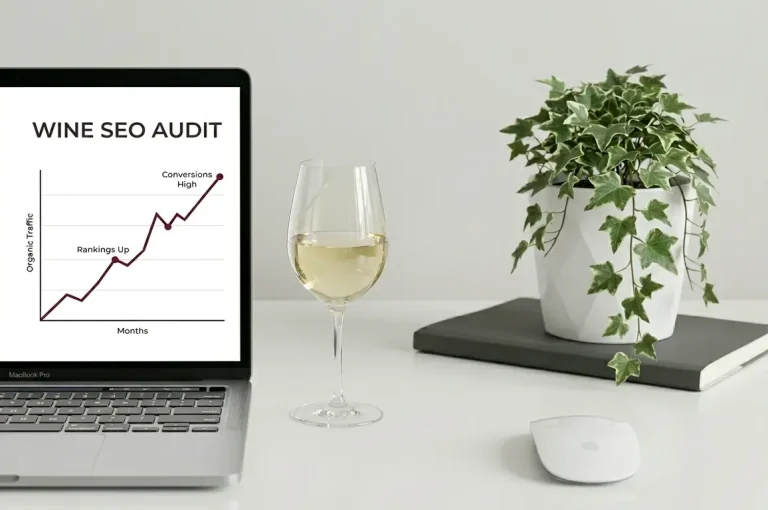
If you would rather have someone run this audit for you, I offer SEO audits for wine businesses that cover every point in this checklist.
Work through these five checks. Be honest with yourself.
1. Can a machine identify your business?
Search your winery name on Google. Does a Knowledge Panel (a box with all the curcial information about your business) appear on the right side of the results? Does it show your correct address, phone number, opening hours, and website? If the panel is missing or wrong, your entity data is weak. That is the first thing to fix.
2. Are your pages indexed?
Go to Google Search Console. If you do not have it set up, set it up today. Check the Coverage report. Find out whether Google can see your full site or whether pages are being blocked or ignored. A page that is not indexed does not exist as far as any AI system is concerned.
3. Is your schema markup valid?
Go to search.google.com/test/rich-results. Paste in your homepage URL and your key wine page URLs. Google will tell you exactly what structured data it can find and whether it is working correctly. If the result comes back empty or with errors, you have work to do.
Schema is not a guaranteed path into AI results, but it is a clean signal that your site is well maintained and your data is structured. That is worth having.
4. Is your product information readable and current?
Go to your best-selling wine page. Check whether the price, availability, and a direct purchase option are all visible in plain text. Then check whether that same information exists anywhere in a PDF or image file instead of on the page itself. If it does, move it.
5. Does your site contain anything only you could have written?
This is the hardest question. It is also the question most winery owners struggle to answer honestly. Read your About page, your wine descriptions, any winemaker notes you have published. Ask yourself honestly: could this copy appear on any other winery website in the country? If the answer is yes, it is not working hard enough for you. AI systems cite sources that contain specific, credible, first-hand information. Generic copy does not get cited.
FAQ
Does AI use my website content to recommend my winery?
Yes. AI models like ChatGPT and Perplexity pull information from websites they identify as credible sources. If your site contains specific, verifiable details about your winery, you are significantly more likely to be cited.
Will schema markup guarantee I appear in AI search results?
No. There is no guaranteed shortcut to being recommended. However, schema markup provides machines with a clear map of your business entity, reducing the chance that an AI overlooks you due to a lack of technical clarity.
Why is my website feel “invisible” to AI?
AI models prioritize unique, high-value information. If your copy relies on generic marketing phrases like “passionate about wine” or “hand-crafted,” you provide no data for the AI to synthesize. Replace these with specific facts about your soil, vintage conditions, and production methods.
How often should I update my Google Business Profile?
Update it whenever your hours or contact details change. At a minimum, review it quarterly. Consistency between your website, social profiles, and directory listings is a primary factor in how confidently an AI recommends you.
Where to Start
If you have found problems in every one of those five areas, do not try to fix everything at once.
Start here, in this order:
- Fix your Google Business Profile first. It is the quickest win and it feeds directly into AI recommendations for local searches.
- Add or correct your schema markup. Send the code examples in this article to whoever manages your website and ask them to check what is already there and what is missing.
- Rewrite one page with real specificity. Your About page or your flagship wine page. Make it contain detail that could only come from you. See how that changes what AI systems say about you when you search your own name.
- Then work through the rest: consistency across directories, product page completeness, booking journey, mobile usability.
AI visibility for wineries is not a one-week project. But the first steps take hours, not months. The wineries that show up in AI recommendations are not doing anything extraordinary. They have simply made it easy for machines to understand them and trust them.
Most of your competitors have not done this yet. That gap will not stay open forever.
Want help with your winery’s AI visibility?
I combine a decade of wine writing, WSET certification, and hands-on SEO experience to help wine businesses get found, trusted, and chosen. Whether you need a wine SEO audit, ongoing SEO management, or wine content written by someone who knows wine, I can help. For details see my wine SEO services.